Zum Inhalt springen
Completed MVP

Web application / internal business software

Geräte-Nachverfolgung

A web application for transparent tracking of internal IT devices across multiple processing departments.

Geräte-Nachverfolgung: Web application / internal business software
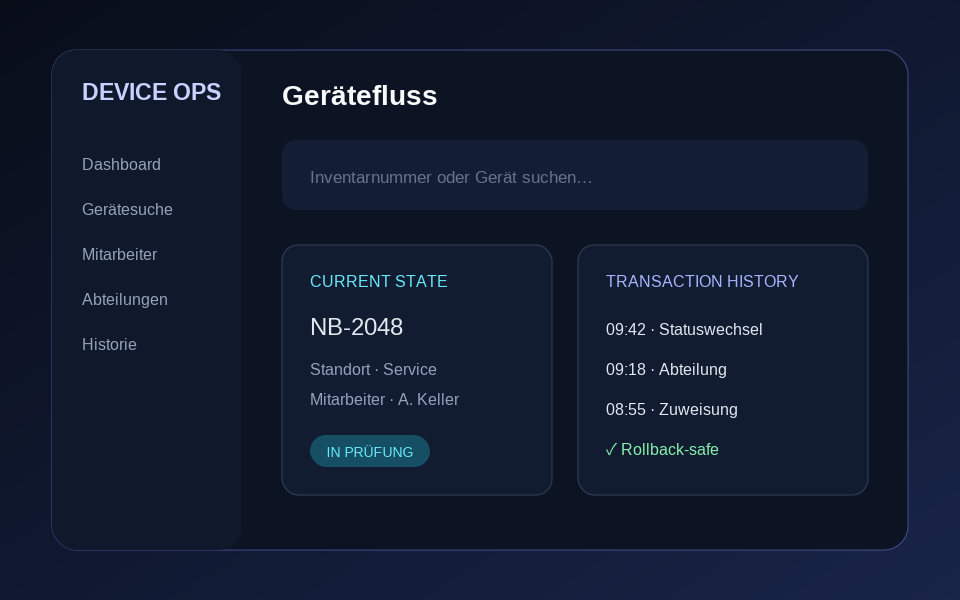
Illustrative project visual · not a screenshot

Project overview

The application centralizes device location, status, responsible department, assigned staff, and immutable change history.

Problem

Device locations, processing states, and responsibilities were difficult to track and required significant manual effort.

Solution

A central dashboard combines search, detail views, status changes, department transfers, and transaction-safe history.

Capabilities at the current project stage

Features

  • Dashboard and device overview

  • Search by inventory number and device data

  • Status and department changes

  • Staff assignment

  • Immutable history entries

  • Error handling with rollback

Technical approach

React and Vite power the interface. Node.js and Express provide a REST API, with MariaDB storing the data. Transactions and rollback protect status changes and history.

ReactViteJavaScriptNode.jsExpressMariaDBREST APIAxiosBootstrap

Role

  • Requirements analysis
  • Architecture and database modeling
  • Frontend and backend development
  • Test planning and technical documentation
React + Vite
Express REST API
MariaDB
Transaktionssichere Historie

Technical case study

How data, state and history remain consistent

Data model and traceable states

The MVP separates a device’s master data from its current location, processing state, responsible department and assigned person. Changes are not stored only on the current record; they are also appended to a chronological history so the previous state remains traceable.

  • Inventory number as the unambiguous search and assignment key
  • Separate fields for location, state, department and assignment
  • Chronological history instead of context-free overwrites

REST API and transaction-safe updates

The React interface communicates with an Express REST API through Axios. Multi-part changes such as a state transition, department transfer, assignment and history entry are treated as one operation in MariaDB. If one part fails, a rollback restores the operation so current state and history cannot diverge.

MVP test strategy

Test planning focuses on the domain transitions with the highest risk: unambiguous device search, state and department changes, staff assignment, invalid or incomplete requests and rollback of an interrupted operation. It also checks that the history entry matches the device state that was actually stored.

Public scope and privacy

This case study describes only the completed MVP and publishes no client name, production data or internal security details. The interactive view on this page is a local simulation with fictional device data. It demonstrates the workflow but is not connected to a production database.

Local interactive simulation

Try the device workflow

Mock data demonstrates search, status changes, assignment and history. No production data is used.

Traceable MVP workflow

  1. 1Find a device unambiguously by its inventory number.
  2. 2Update location, status, department and responsible person together.
  3. 3Record every change in the history and roll back failed operations.

Enter INV-1042 to open the simulated device.

History

  1. Device registered in the system

Status & next steps

Completed MVP

The MVP is complete. This case study focuses on traceable responsibilities and consistent device histories. No public demo is available.

Technical challenges

  • Keep current device state and history consistent during multi-part updates
  • Fully roll back failed state or department transitions
  • Find devices by unique inventory numbers and avoid mismatches
  • Explain the domain workflow publicly without exposing production data

Discuss a similar project

From a specific challenge to a fitting application.